Monday, June 14, 2010

Drive up through the Sequoia's


This is the first trip that we made without the aide of a paper map, relying instead on Google and Morticia's GPS ( Morticia is my car)  While we did end up a little out of the way and at least once wondered which fork in the road to take, we basically travelled about the most scenic route possible.


This is Lake Isabella. Jeff mapped out a 'back way' route for us which took us past this man made lake and dam on our way to the Sequoias.

 A beautiful sun lit meadow and . .  much to our surprise- Snow!


In case you have no knowledge of the Sequoia trees, here is a sample. The big redwood trunk- this one split in 2 from a fire long ago, is an example of a big, but certainly not the biggest of the red giants! The trees to either side of it are at least 30-40 feet tall!  Here is a little info on Sequoia's.

Sequoia National Park is a national park in the southern Sierra Nevada, east of Visalia, California, in the United States of America. It was established on September 25th, 1890. The park spans 404,051 acres (1,635 km2). Encompassing a vertical relief of nearly 13,000 feet (4,000 m), the park contains among its natural resources the highest point in the contiguous 48 United States, Mount Whitney, at 14,505 feet (4,421 m) above sea level. The park is south of and contiguous with Kings Canyon National Park; the two are administered by the National Park Service together.

The park is famous for its Giant Sequoia trees, including the General Sherman tree, the largest tree on Earth. The General Sherman tree grows in the Giant Forest, which contains five out of the ten largest trees in the world, in terms of wood volume. The Giant Forest is connected by the park's Generals Highway to Kings Canyon National Park's Grant Grove, home to the General Grant treeamong other sequoias. The park's Giant Sequoia forests are part of 202,430 acres (81,921 ha) of old-growth forests shared by Sequoia and Kings Canyon National Parks. Indeed, the parks preserve a landscape that still resembles the southern Sierra Nevada before Euro-American settlement.
We picked the best time to travel through this area. It is prime snow melt time and all the waterfalls were full! These were roadside!
Getting up there!
On our way down the mountains, we passed this cute deer. She wanted nothing to do with us and hurried on her way!
 We ended up here- wherever that is and then proceeded on through every possible back road until we found Fresno.
These tiny pink beauties were all over the hills in this area.

Sunday, June 6, 2010

Corpse Flower- Amorphophallus titanum


Jeff and I are officially on vacation. Our first excursion turned out to be to the Huntington Gardens in San Marino. It seems that the Huntington has been lucky enough to have a third blooming of a Corpse flower. The one this year is the product of an experimental pollination done on the bloom from 1999. A Corpse Flower bloomed in 2009 also. 
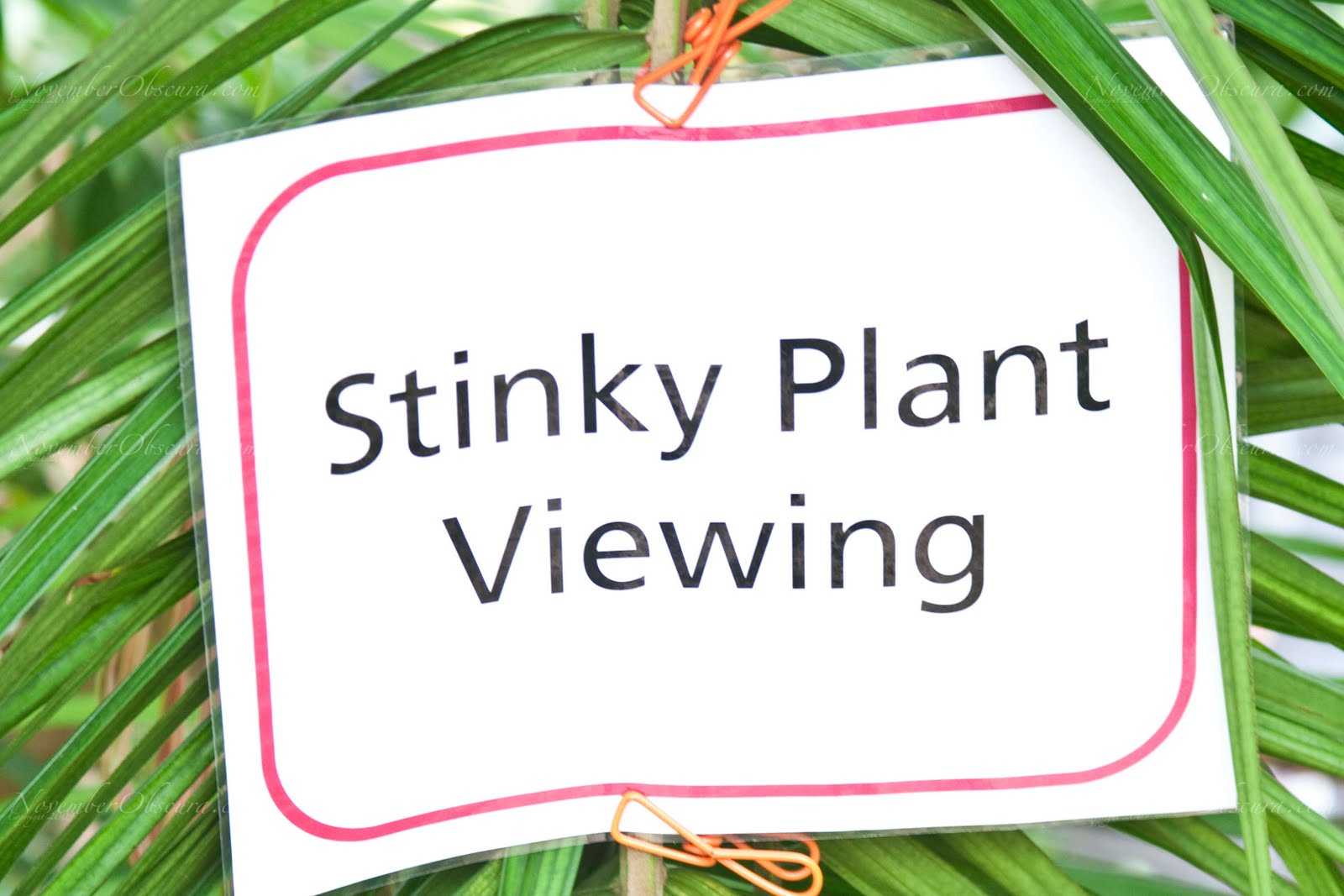
I have been following and found out that a blooming was immanent.  On Friday afternoon about 2 PM the Huntington announced that the bloom had started to open, a process which can take as long as 7 hours.  So we headed over there on Saturday, arriving around noon and scurried straight to the Conservatory where Stinky the Corpse Flower resides. Signs posted with a red arrow pointed the way to Stinky's abode.


The Conservatory


These signs were posted inside the Conservatory at the prime viewing spots. Stinky was located on the lowest level of the 85 degree, 52 % humidity green house, almost under the upper walkway. The closest we could get to her was about 10 feet away. 
The bloom had already begun to close, and the famous order was not present. These flowers only smell for about the first 12 hours when open, to attract the beetles, flies and bees that it needs to assist in pollination. There was however a bottle of 'sample stink' which I took a whiff of and indeed the odor was like extremely putrified meat.


 Stinky is 44 inches tall


Luckily, Stinky was open enough to still display her beautiful dark magenta inner color


Great Colors


The tall column part of the plant is called the spadix, about a week after the blooming it will rot away naturally. The outside petal like cover that is red inside is called the spathe. The 'flower' can grow up to 6 inches per day! At 44 inches Stinky was rather short for her species. About 6 months after the blooming there will be a 'fruit' that contains seeds where the bloom is now.


Saturday, May 22, 2010

Road Trip coming soon!


If this image seems a little familiar , it was part of our post on Alcatraz, just one of the sights we saw on our trip to San Francisco last year.

I realize it has been months since I have posted a new blog here, so I thought I would post that new photos/blogs are coming! We are on Vacation soon and are working out our destination. We will of course chronicle it in photos.

Sunday, February 28, 2010

Ludlow Cemetery


In a much earlier blog, we went over our first visit to Ludlow, CA. Once a stop along the famous Route 66, it is now almost a ghost town. In fact it looks much more the worse for wear. See the picture above. Passing through the first time, we did not find the cemetery. This fact has bugged me for more than a year, so  since I knew we would be going through again, I did a little research and was able to obtain a description of where it might be.

To get there we had to go up a dirt road, and then get out to walk and cross a double set of train tracks that several signs warned up to stay away from.  The Cemetery is as sad and desolate as Ludlow is. 


Mount Calvary Cemetery - Albuquerque, New Mexico


Here is a little info about this cemetery. As cemeteries go , it was not really remarkable. Although beautiful and well kept up, the older section looks like it has had a problem with vandalism. Also the entire area back there seems to have a layer of very sharp sticker plants growing over the grass. The bottom of my shoes were coated with the things and it took over a month to get them all out.


The Mount Calvary cemetery can be reached from Lomas Boulevard, turn north on Edith Blvd and continue to Indian School Road. Here you will see it on the east side of Blvd.
The original (oldest) section is called Santa Barbara and is listed as SB in the burial locations.
In 1869, the Jesuit Fathers in Albuquerque announced they would be building a new chapel and new cemetery. The old cemetery near the San Felipe de Neri Church would no longer hold burials. Father Donato Gasparri found a better site three miles from the Old Town site. The greater number of the bodies from the old grounds were carefully moved in 1869.


The first recorded interment was August 1870. The earliest existing monuments are those of Vicente Otero (1877), Jesusita Baca de Romero (1877) and Diego Armijo (1878).
In 1936, the Reverend Libertini chaired a committee to modernize and beautify the cemetery. In 1938, a solemn high mass dedicated the new chapel and cemetery. The parishes of San Felipe and Immaculate Conception used Santa Barbara Cemetery which later became a part of the newer larger Mount Calvary Cemetery.


The new cemetery consisted of an additional eighteen acres of land north of the older Santa Barbara portion. I new chapel was built in 1992 as well as a mausoleum. The original business office is now a columbarium for cremated remains.
Blog Widget by LinkWithin